Franken Rolex Datejust 16233 Style Build: Genuine Arabic Jubilee Dial on a 3135 Clone
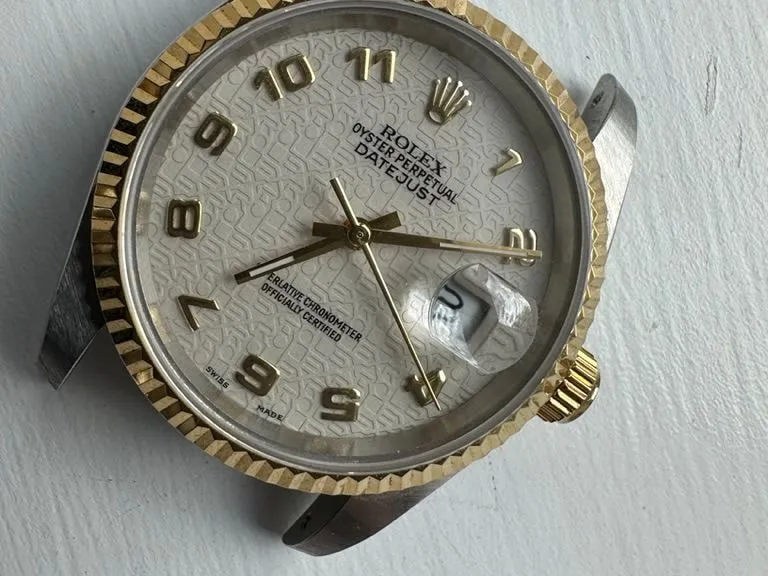
My second two-tone Datejust franken pairs a genuine ivory Arabic Jubilee-pattern Rolex dial with a 3135 clone movement, the calibre the dial was made for.
Parts used
- Movement
- 3135 clone automatic
- Dial
- Genuine Rolex ivory/white Arabic Jubilee-pattern dial
- Case
- Two-tone 36mm Datejust-style case, fluted gold-coloured bezel
- Hands
- Gold-tone Datejust-style hands
- Strap
- Tan suede with cream stitching
- Bracelet
- Two-tone jubilee
Some of these are affiliate links. Buying through them costs you nothing extra.
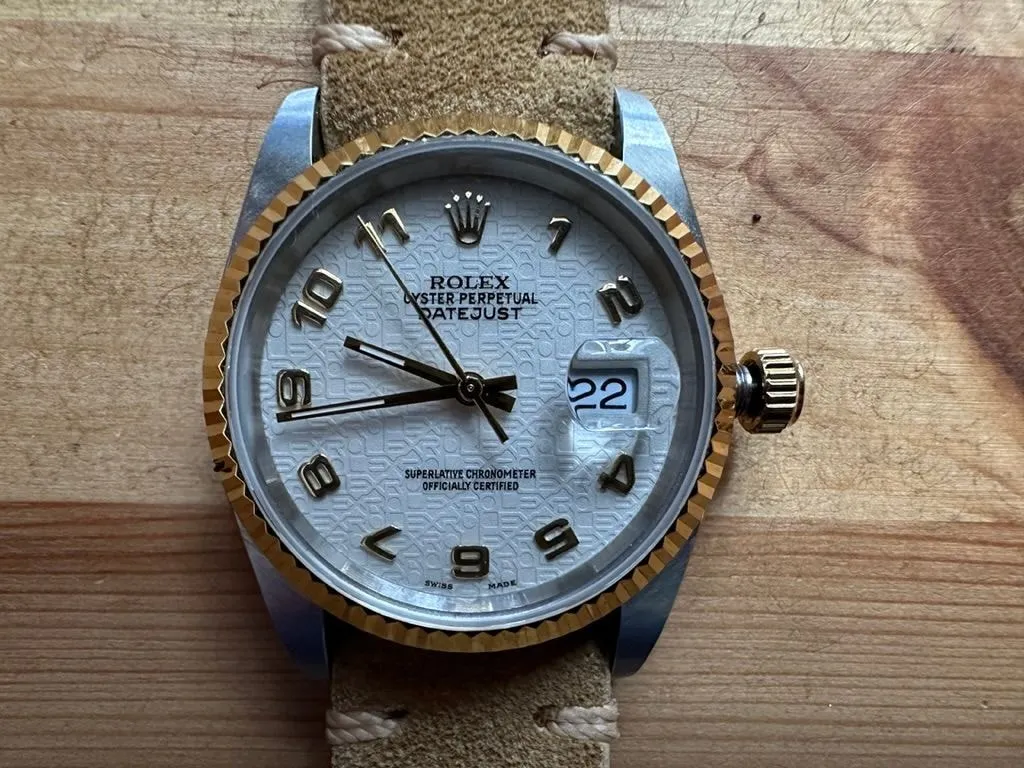
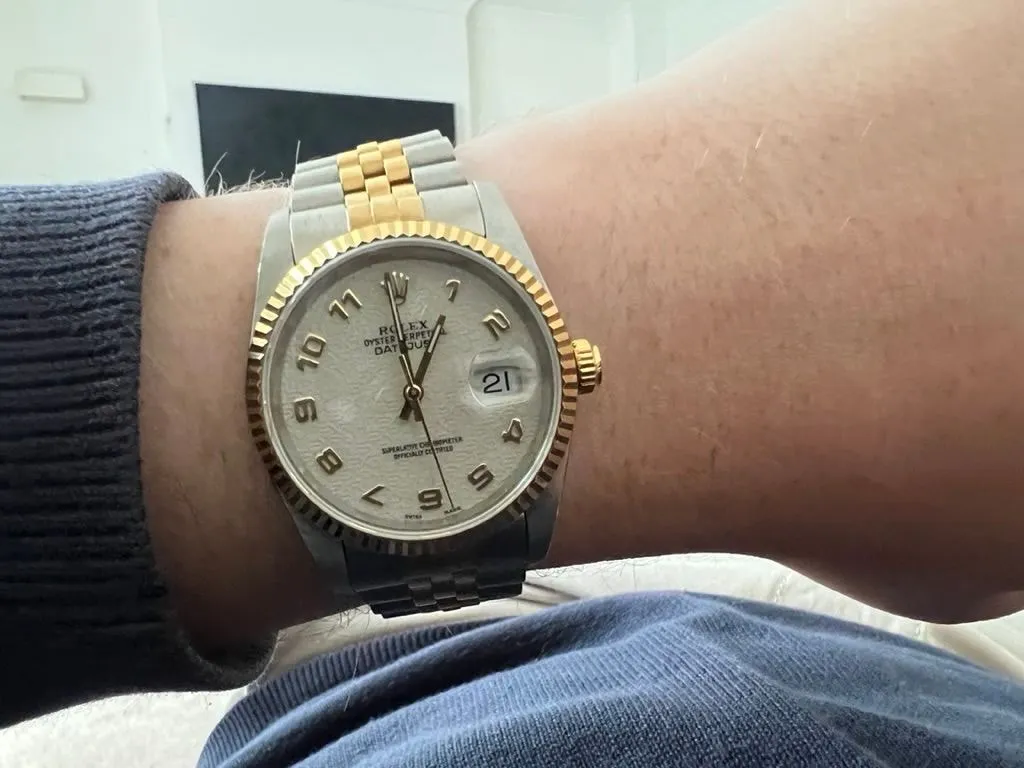
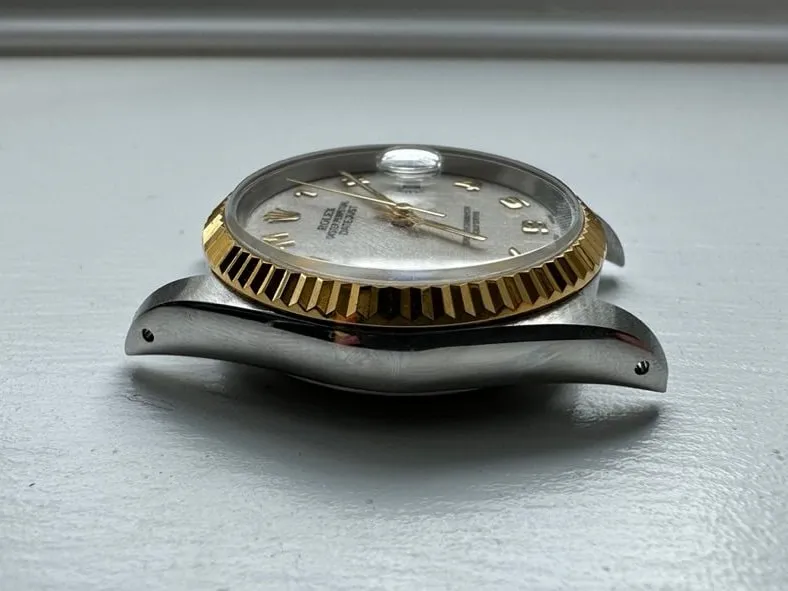
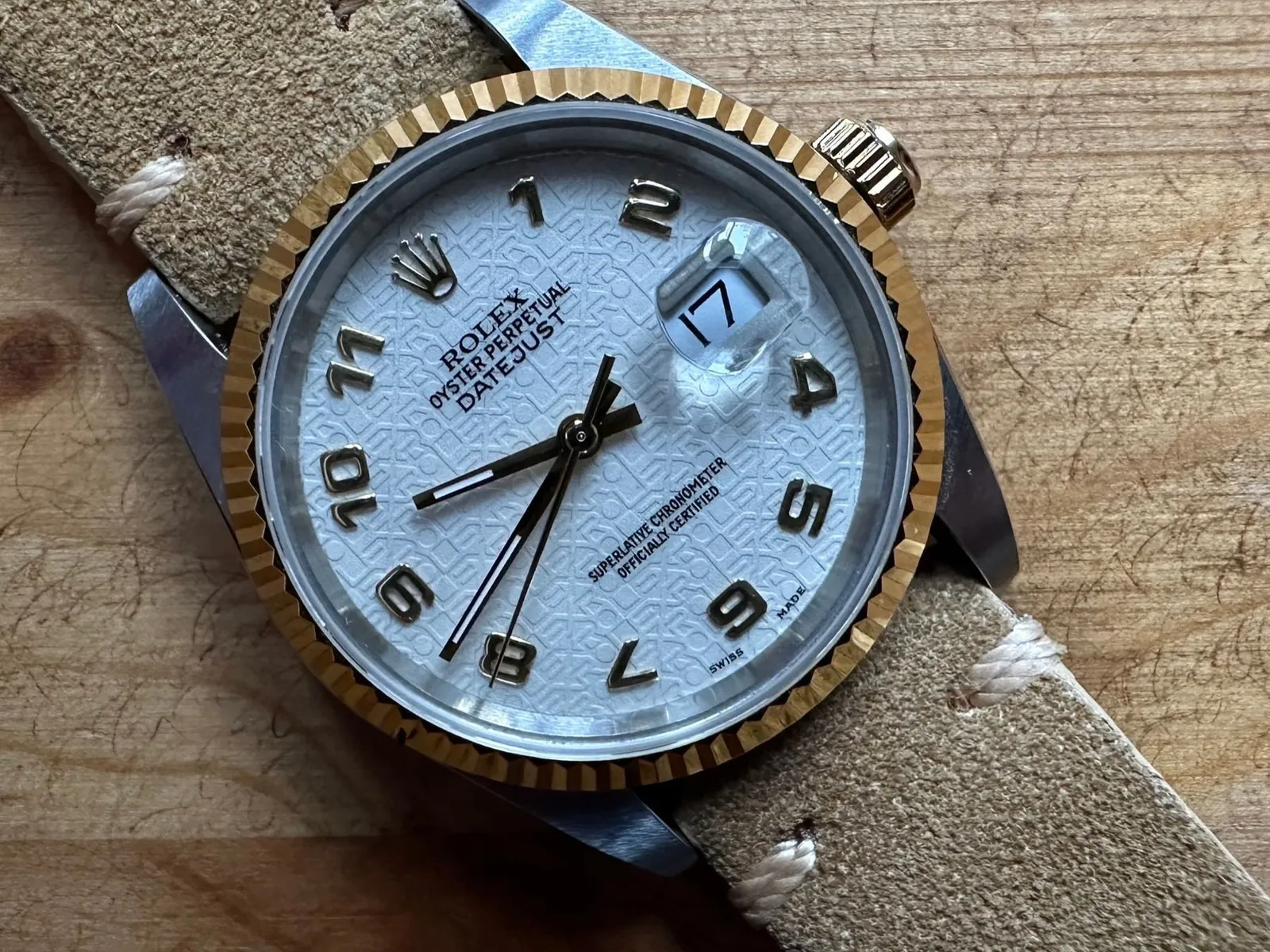
This is my second two-tone Datejust franken. It's built in the style of a 16233: a 36mm two-tone case with a fluted yellow-gold-coloured bezel, a 3135 clone movement, and at its heart a genuine Rolex ivory/white Arabic dial with the "Jubilee" ROLEX motif engraved right across it. I've worn it on a tan suede strap with cream stitching and on a two-tone jubilee bracelet, and both are shown below.
If you've read my first two-tone Datejust franken, you'll know that one paired a genuine 16013 dial with a 2836 movement, which meant cutting off the dial feet and gluing new ones on. This build takes a different route, and that's most of what this post is about.
Why build around a genuine dial?
A franken, in the proper sense, is a watch that mixes genuine parts from one brand with parts from elsewhere, and is described honestly as exactly that. The dial is the part you look at every time you check the time, so it's where a genuine part makes the biggest difference. Printing, applied numerals and the texture of an engraved pattern are very hard to copy convincingly, and a genuine dial with a bit of age has a character that a new aftermarket one doesn't.
Everything else here is aftermarket, and I'd rather say so up front than leave anyone guessing. It's a hobby build, made to wear, not to pass off as anything it isn't.
I'd wanted an Arabic Jubilee dial since owning my 16220. I checked the printing under a loupe against photos of known originals, and the SWISS MADE text matched the era.
I bought the dial on eBay for about £100.
What is the Rolex Jubilee dial?
The Jubilee dial, also called the anniversary dial, has the word ROLEX engraved repeatedly across the whole surface in a staggered pattern. It's usually dated to 1985, for the Datejust's 40th anniversary, though Rolex doesn't publish this sort of history, so treat the date as received wisdom rather than fact. It turns up on the 16013, on the 16233 in cream and white Arabic versions, and on the steel and white gold 16234.
Arabic numerals seem to be the less common pairing. The motif was typically paired with Roman numerals or diamond hour markers, which matches what you see when you browse listings, though nobody publishes production numbers.
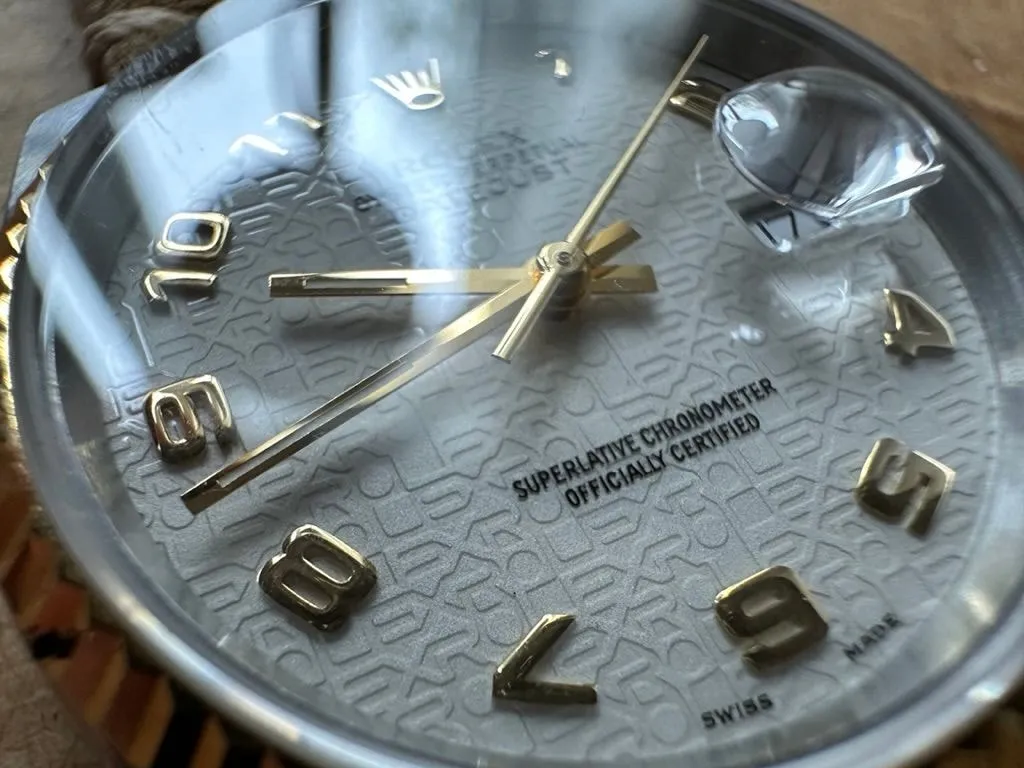
Dating a dial from the text at 6 o'clock
Rolex doesn't publish production dates by reference, but the small print at the bottom of the dial is a useful guide to its era, because it changed with the luminous material. The usual sequence is:
| Text at 6 | Lume | Rough era |
|---|---|---|
| T SWISS T or SWISS T<25 | Tritium | Up to the late 1990s |
| SWISS | Luminova | Roughly 1998–99 |
| SWISS MADE | Super-LumiNova | Around 2000–01 onwards |
Figures vary on exactly when SWISS MADE started (anywhere from 1999 to 2000 for the Datejust, and 2001 for some sports models), so "around 2000–01" is the safest way to put it. One trap: T SWISS T doesn't always mean tritium, as some Japanese-market dials carry the T with no lume at all because of import restrictions.
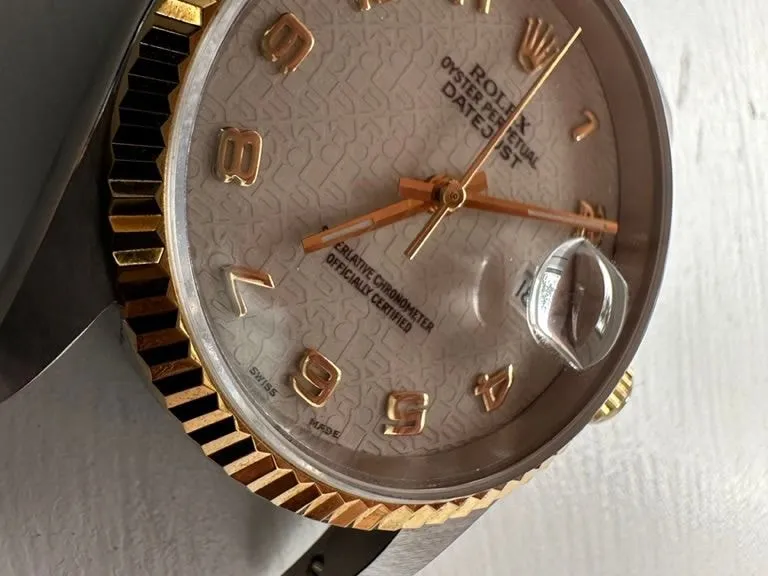
My dial reads SWISS MADE, which you can see in the close-up above. The 16013 ran from 1977 to 1988, so a genuine 16013 Jubilee dial should carry tritium text from a window of roughly 1985–88. A SWISS MADE ivory Arabic Jubilee dial therefore can't be from a 16013; it comes from a late 16233 or a 16234, from around the turn of the millennium onwards. That dates the dial and makes the 16233 the reference this build echoes.
16013 vs 16233 in brief
The two two-tone Datejusts that wore this dial are easy to mix up, and my two builds sit either side of the line between them:
| 16013 | 16233 | |
|---|---|---|
| Production | 1977–1988 | From 1988 |
| Calibre | 3035, 27 jewels | 3135, 31 jewels |
| Crystal | Acrylic | Sapphire |
| Bezel | 14k or 18k gold, fluted | 18k gold, fluted |
| Quickset date | One date per crown turn | Three dates per crown turn |
| Setting the time | Counter-clockwise | Clockwise |
The 3135 runs at 28,800 vph, has a full balance bridge and is usually quoted with a 48-hour power reserve (figures vary from 42 to 50 hours). Early 16233s used a Nivarox hairspring; Parachrom came in around 2000, so not every 16233 has it. For how a modern two-tone Datejust compares with my builds, see my 126234 vs Datejust builds post.
Why a 3135 clone for a 3135-era dial
This is the key decision in the build. A genuine Datejust dial is made for Rolex's own calibres, and aftermarket dial sellers list their Datejust dials as fitting both the 3035 and the 3135, which suggests the two share dial fitment. The genuine 3135 is 28.50 mm across and 6.00 mm high (that's the movement, by the way, not the dial).
The usual franken problem is putting a Rolex dial on an ETA 2824 or 2836-type movement, where the feet don't line up. That's exactly what I did on the 16013 build: snip the feet, file the stubs flush, glue on new copper feet and fit a date wheel overlay. It works, but bending feet to fit tends to snap them, and dial stickers can let a dial shift when the watch warms up in summer.
A clone built to the 3135 pattern sidesteps all of that, in principle. The dial feet should drop straight into the holes they were designed for, the date wheel sits where the dial expects it, and the quickset and time-setting should behave like a 3135. I can't confirm this for 3135 clones in general, so treat what follows as one build on one bench, not a rule.
I used a 3135 clone movement from eBay.
Fitting the dial and hands
I didn't photograph every step of this one, so if you want the full step-by-step process with photos, the silver dial Datejust build covers dial, hands and casing in detail, and my guide to fitting watch hands goes through the hands.
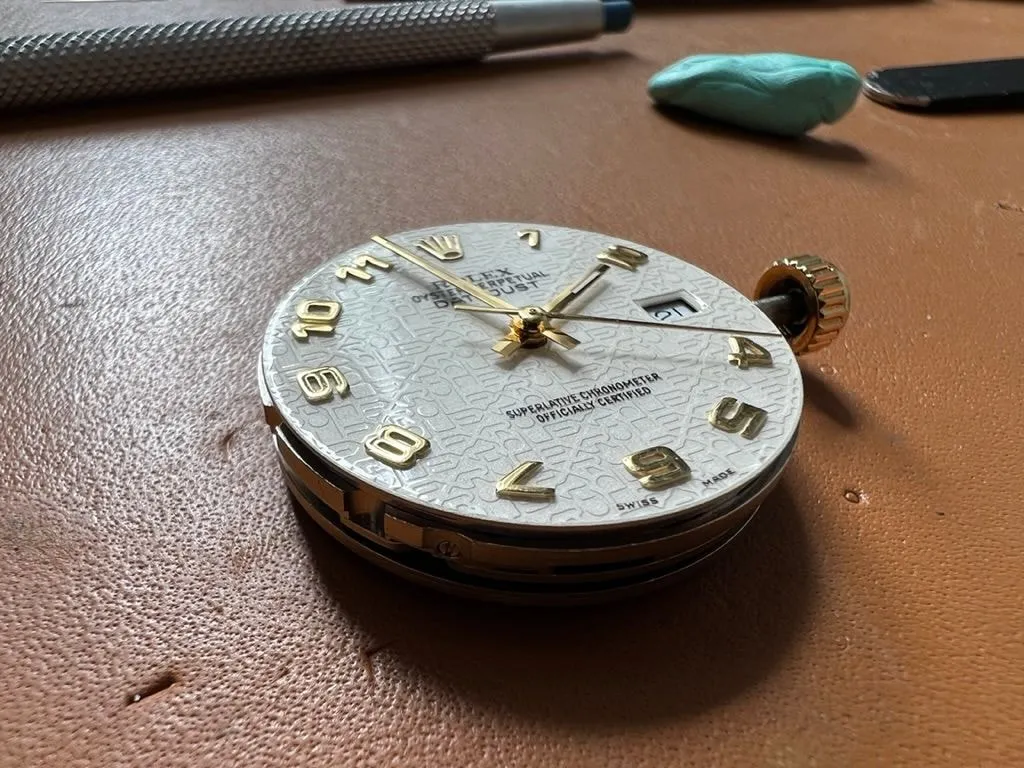
As expected for a 3135-pattern movement, the genuine dial's feet should seat in the clone without cutting, filing or glue, which is the whole point of choosing this movement.
On mine it did. The feet dropped straight in with no cutting or glue, the date lined up under the cyclops without an overlay, and I used the movement ring that came with the case. The gold hands came from eBay, made for the 3135, and fitted without reaming.
I didn't hit any problems. It was the easiest of my Datejust builds, because the dial was made for the movement.
Once the hands are on, run them through midnight a few times and check the date flips cleanly, then time the movement before casing it. My timegrapher app guide covers that.
The case
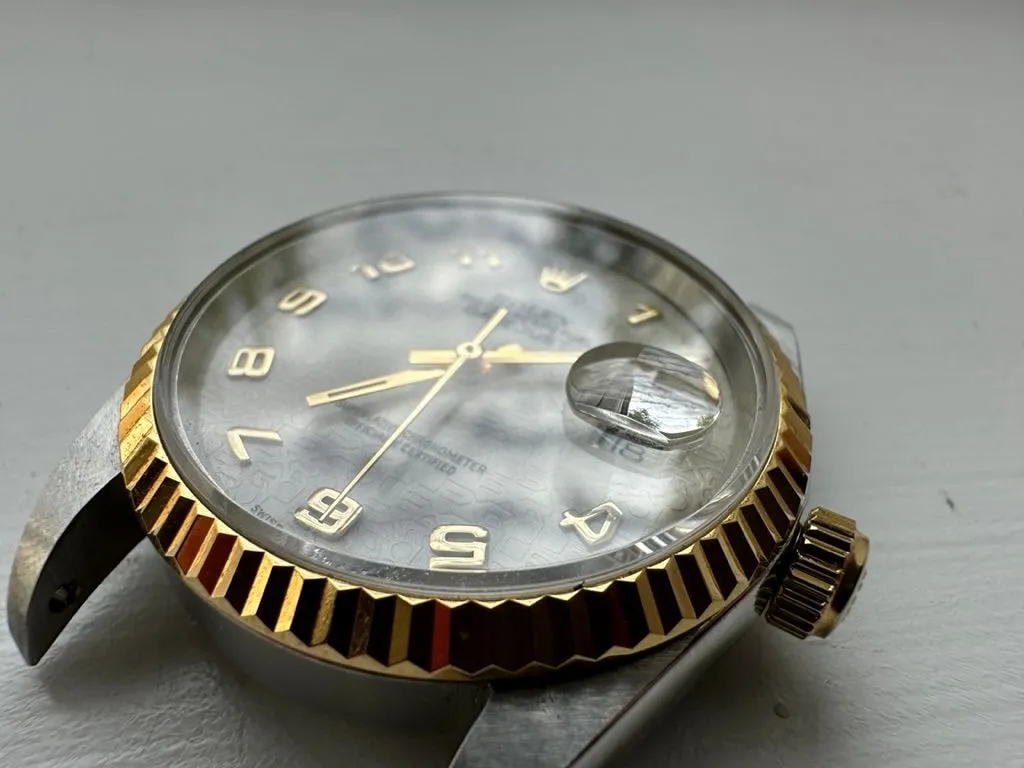
The case is a two-tone 36mm Datejust-style case with a fluted yellow-gold-coloured bezel and a matching crown. On the genuine 16233 the bezel is 18k gold.
The case came from eBay, and the bezel is gold plated.
The crown is aftermarket, like the rest of the case. The dial is the only genuine Rolex part on this watch.
Tan suede strap vs two-tone jubilee bracelet
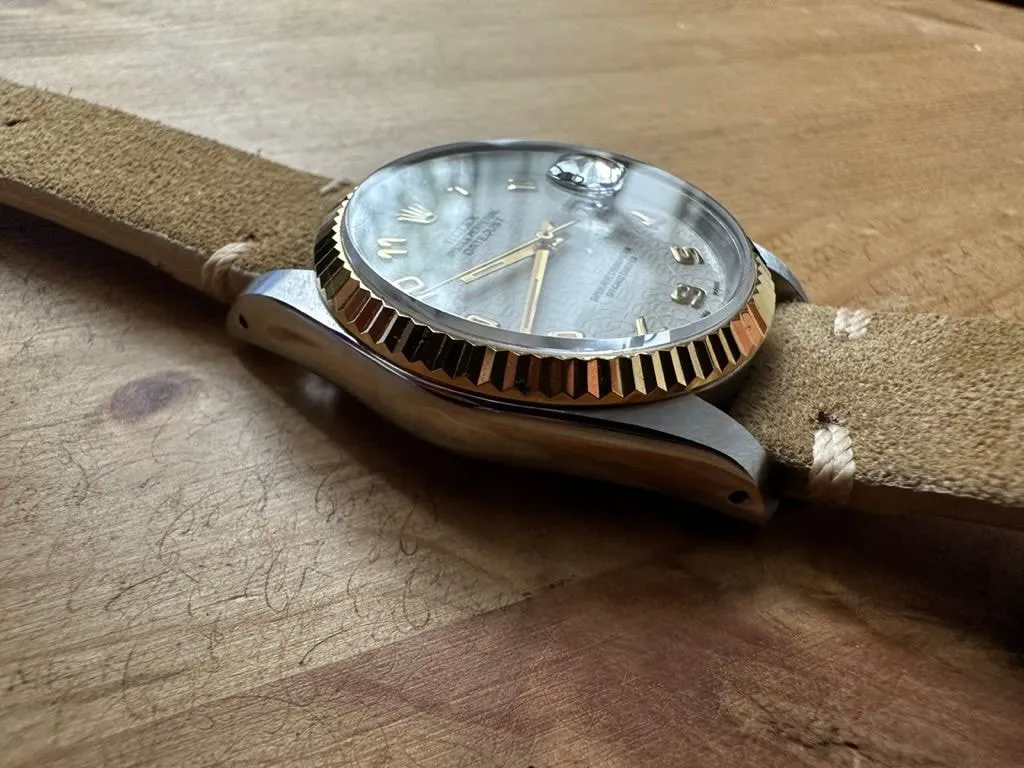
The watch works two ways. On the tan suede strap with cream stitching it's a more casual look, with the ivory dial and gold-coloured bezel sitting alongside the warm tones of the suede. The light catches the engraved pattern differently on the strap shots too, and in some photos the dial reads almost white.
On the two-tone jubilee bracelet it becomes the classic two-tone Datejust look, with the gold centre links tying in with the bezel and crown.
Get a Two-Tone Jubilee Bracelet
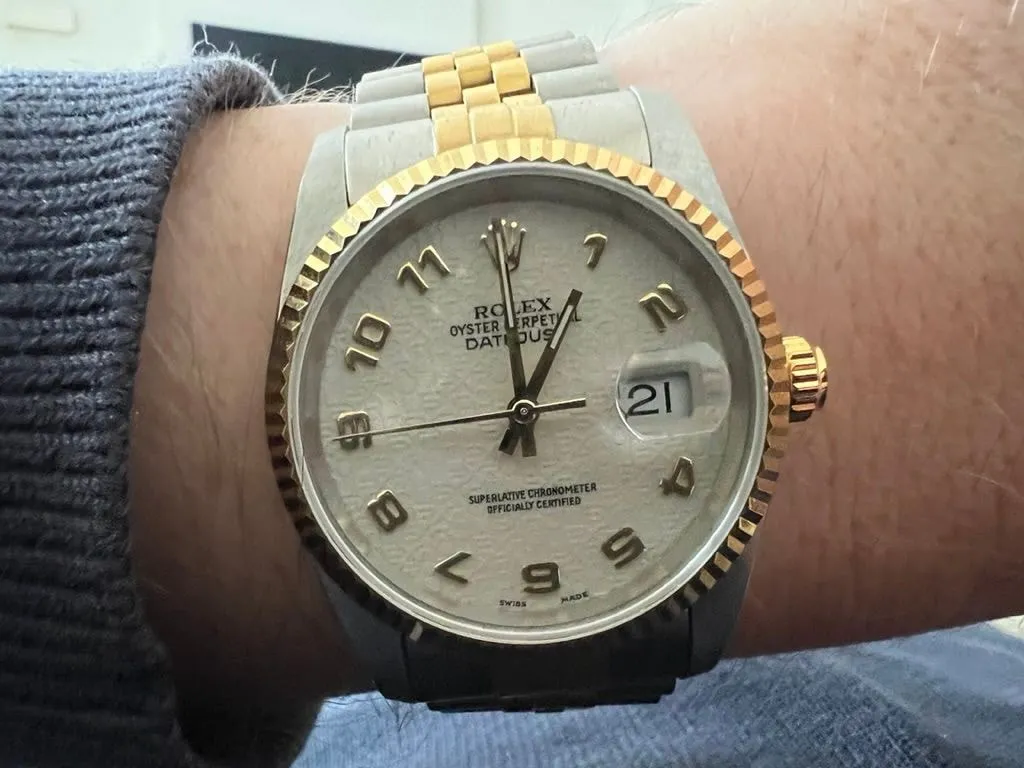
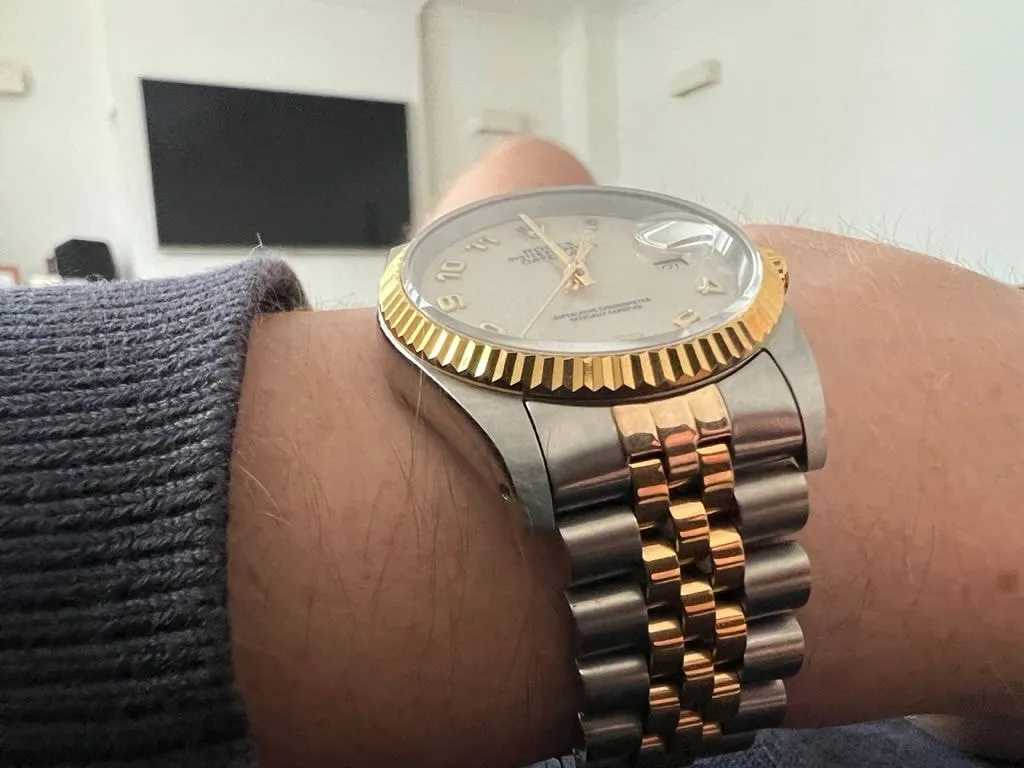
I wear it on the jubilee bracelet most days, and switch to the suede strap in summer. Both came from eBay.
How to spot a redial when buying a genuine dial
If you want to build one of these, the dial is where your money goes and where you can get caught out. A refinished (redialled) dial is worth much less than an original one, and the tells are usually in the printing. These are the main things to check:
- Fonts and spacing. Compare the text letter by letter with a known original from the same era. Uneven spacing, thick strokes or wrong letter shapes are the classic signs.
- The text at 6. Refinishers often skip the SWISS or SWISS MADE print pass, so a missing or odd-looking line at the bottom is a warning.
- Lume that doesn't match. On a lumed dial, marker lume should match the hands and the era of the text.
- Too new for its age. A dial that looks perfect but supposedly came out of a 30-year-old watch deserves a closer look.
- Era consistency. Use the 6 o'clock table above. A seller calling a SWISS MADE dial a "16013 dial" has the dating wrong, whatever else is true.
A loupe makes the printing much easier to check.
My dial cost about £100 on eBay. My where to buy watch parts in the UK guide has more on buying parts safely.
A note on selling frankens in the UK
This isn't legal advice, and the law here is genuinely unsettled. I couldn't find any UK case law or Trading Standards guidance specific to frankenwatches. The general point is that section 92 of the Trade Marks Act 1994 makes it an offence, with a view to gain, to sell goods bearing a trade mark without the owner's consent, and the Supreme Court held in 2017 (R v M) that this can reach goods that started out genuine. So "the dial is genuine" isn't the defence many hobbyists assume it is. Traders also have to avoid misleading descriptions under the consumer protection rules that came in on 6 April 2025.
Building and wearing a franken yourself is the lowest-risk case. If you ever sell one, describe it as a franken or modified watch, never as a Rolex, and list every part and whether it's genuine. Something like: "Franken Datejust-style watch: genuine Rolex dial; aftermarket case, bezel, crown, hands and bracelet; 3135 clone movement. Not a Rolex watch." Any aftermarket part that carries a Rolex coronet or engraving is a problem in itself, so that's worth checking before you even list it. If you're selling seriously, get proper advice.
The finished build
The finished watch combines the genuine engraved Jubilee dial, its applied gold Arabic numerals, the two-tone case and fluted bezel, and a movement chosen to match the dial's original calibre.
It's kept good time since I built it, and the clone has run without problems. Next time I'd photograph every step.