Rolex GMT-Master II 16710 Guide: Pepsi, Coke, Black and Stick Dials
I have owned a Pepsi and a black 16710. Here is what the "II" really means, how to date one from its dial, what they sell for, and which one I would keep.
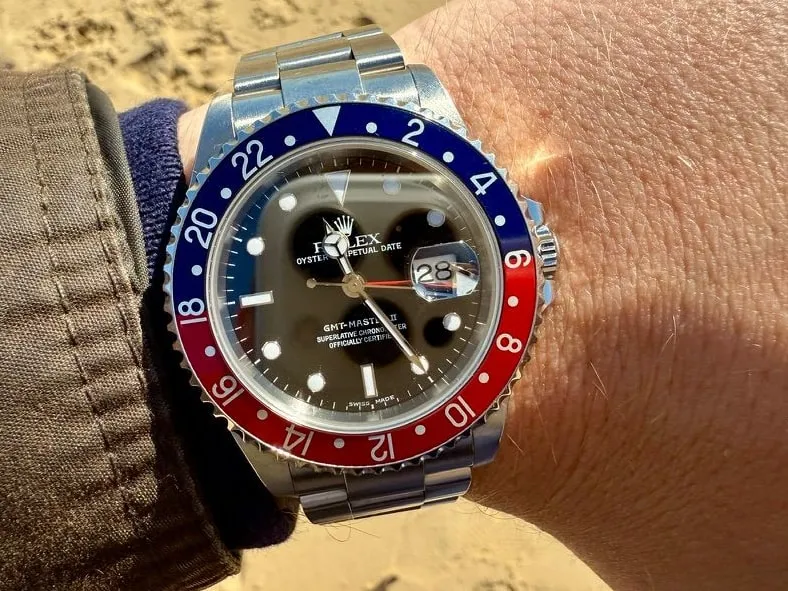
The 16710 is the five-digit GMT-Master II: steel, aluminium bezel insert, slim pre-maxi case, and made from circa 1989 to 2007 in three colourways, the blue and red "Pepsi", the black and red "Coke" and plain black. It replaced the 16760 "Fat Lady" and gave way to the ceramic 116710. It was the last GMT-Master II with an aluminium insert and the slimmer case, which is a big part of why it's so popular now.
I've owned two: the Pepsi in the photo above and a plain black one. If I could only keep one, it would be the black, and I explain why further down.
Rolex 16710 at a glance
| Reference | 16710 (GMT-Master II, steel) |
| Made | c.1989–2007 |
| Case | 40 mm Oyster case, 20 mm lug width, 100 m water resistance |
| Bezel | Two-way rotating, 24-hour aluminium insert: Pepsi, Coke or black |
| Movement | Cal. 3185 (late watches 3186), 28,800 vph, about 50 hours' power reserve |
| Bracelet | Oyster, most often the 78790 / 78790A |
| Replaced by | The ceramic 116710 (from 2007) |
This guide covers what the "II" actually means, how to date one from the dial and case, the stick dial, inserts and fading, how to use the bezel and 24-hour hand, and what they sell for. Rolex publishes no production dates by reference, so every date here comes from dealers and auction houses that often disagree by a year or two. Read them as "circa".
GMT-Master vs GMT-Master II: 16700 vs 16710
For most of the 16710's life Rolex also sold the cheaper 16700 GMT-Master (1988–1999). They look almost identical, so it's easy to assume the "II" is just branding. It isn't. It marks a real mechanical difference:
| 16700 GMT-Master | 16710 GMT-Master II | |
|---|---|---|
| Calibre | 3175 | 3185 (late watches 3186) |
| Made | c.1988–1999 | c.1989–2007 |
| Independent local hour hand | No | Yes, jumps in one-hour steps |
| Number of time zones shown | Two (three with the bezel) | Two (three with the bezel) |
On the 3185 you can move the main hour hand on its own, an hour at a time, without stopping the watch or disturbing the minutes or the 24-hour hand. That's what travellers want: land, pull the crown out, jump the local hour, done. The 16700's 3175 has no independent hour hand at all. In today's language the 3185 is a "flyer" or "true" GMT.
The 3186: a small upgrade, not a big premium
Right at the end of the run, reportedly 2006–07, some 16710s were fitted with the cal. 3186. The main change is a blue Parachrom hairspring, which is more resistant to shocks and magnetism. Otherwise the two are close: both run at 28,800 vph with about 50 hours of power reserve, and both have the independent hour hand. Relatively few 16710s got the 3186.
The myth to watch for is that a 3186 always commands a big premium. In practice the premium is small. Rarity is nice, but you're not buying a different watch, so don't let a listing charge you as though you are.
16710 production years: how it changed, 1989 to 2007
The 16710's changes follow the Submariner 16610's closely (my 16610 comparison covers that side). Most of them landed between about 1998 and 2004, when the lume, the dial text, the end links and the case all changed within a few years. Every date here is circa:
| Years (circa) | Lume and text at 6 o'clock | Case | End links | Movement |
|---|---|---|---|---|
| 1989–1997 | Tritium, "SWISS – T < 25" | Drilled lug holes | Hollow (folded) | 3185 |
| 1998–1999 | Luminova, "SWISS" only | Drilled lug holes | Hollow | 3185 |
| 2000–2001 | Super-LumiNova, "SWISS MADE" | Drilled lug holes | Solid end links arrive | 3185 |
| 2002–2004 | Super-LumiNova, "SWISS MADE" | Lug holes dropped (the 16710T) | Solid | 3185 |
| 2006–2007 | "SWISS MADE", stick dials on some | No lug holes | Solid | 3185, some 3186 |
Sources disagree on exactly when tritium ended, with dates from 1997 to 1999 quoted, so "the late 1990s" is the honest answer. The Pepsi in the photo at the top reads "SWISS MADE", which puts its dial in the 2000s. Tritium dials age to cream or yellow tones, which some buyers pay extra for. The later dials should stay white.
Two of those changes matter day to day. Drilled lug holes let you push the spring bars out from the side, so strap changes are easier and you're less likely to scratch the lugs, which is one reason some collectors prefer the earlier cases. Solid end links rattle less than the folded ones, but they're specific to the case, so check the number stamped on the end link against the case rather than the seller's description. Gaps or wobble at the case usually mean a mismatched bracelet. The bracelet most often cited for the 16710 is the 78790 / 78790A (some listings give "78390", which looks like a transcription error).
The 16710 stick dial: a typeface change, not an error
Late in production some 16710 dials printed the "II" in "GMT-Master II" as two plain strokes instead of serifed Roman numerals. Collectors call these stick dials. Two myths are attached to them:
- "Every stick dial is a 3186." No. Stick dials appear on late 3185 watches as well as 3186s.
- "The stick dial is a factory error." It isn't. It's a minor typeface variation, not a true error dial.
You'll also see it claimed that the stick dial prints "GMT-Master II" on one line. I couldn't find any source that says so: the change is the shape of the numerals, nothing more. As for how rare they are, one estimate from about 400 listings put stick dials at roughly 5–7%. To check one, look closely at the "II" with a loupe: serifs (little feet top and bottom) mean a standard dial, and bare strokes mean a stick dial.
Inserts: Pepsi, Coke, black, and fading
All three colourways share the same case and bezel, so the insert is what makes the watch a Pepsi, Coke or black. Some full sets have been sold with spare inserts, which shows how interchangeable they are. A few points worth knowing:
- The Pepsi is the most popular, but it carries only a small premium. Don't believe the claim that a Pepsi is worth far more than a Coke or a black.
- The Coke 16710 was the last Coke GMT in the catalogue, which gives it its own following.
- The black is the quietest and often the cheapest way into the reference.
Aluminium inserts fade in sunlight, and a Pepsi that has faded to pale pink-purple ("fuchsia") and washed-out blue is sought after. Be careful, though: aftermarket inserts made to look faded have been sold on their own, so a faded insert proves nothing about the watch's age or history. Look at the wear on the insert's edges and numerals, and whether the fading matches the dial and case, rather than at the colour alone. Because inserts swap so easily, the insert is the one part of a 16710 you should always assume might have been changed.
If you're building a GMT-style watch rather than buying one, a sterile insert (24-hour scale, no brand name) and a bezel removal tool are all you need to change colourways.
Pepsi or black? Which one I'd keep
Having owned both, my pick is the black. The Pepsi is the one everyone recognises, and it looks great in photos, but on the wrist the blue and red is a lot. It works with jeans and a white T-shirt; with anything that has its own colour, it starts to clash. You end up dressing around the watch.
The black has the same case, bracelet, dial and 24-hour hand, so you lose nothing in use. It just goes with everything, which means it gets worn. If you want the GMT function rather than the colours, start with the black. It's often the cheaper one too.
How to use the GMT bezel and 24-hour hand
The 24-hour hand (the red-tipped arrow on most 16710s) goes round once a day and reads against the 24-hour scale on the bezel. With the bezel at its zero position, the triangle at 12 o'clock, it shows a second time zone. Turning the two-way bezel gives you a third. The principle is the same on any GMT watch.
Using London as home and travelling to Tokyo as an example:
1. At home in London, 09:00
All hands set to London. The red 24-hour hand points to 9 on the bezel.
2. Landed in Tokyo, 18:00
Only the hour hand jumps forward 9 hours. The 24-hour hand still reads London: 9.
3. Third zone: New York, 04:00
Turn the bezel 5 hours. The 24-hour hand now reads New York: 4.
- Set home time on the 24-hour hand. Unscrew the crown and pull it to the time-setting position. On a 3185 the minute, hour and 24-hour hands move together here, so set them all to London time, making sure the 24-hour hand is on the correct side of noon.
- Check the bezel is at zero. With the triangle at 12, the 24-hour hand reads London time in 24-hour form.
- When you land, jump the local hour hand. Pull the crown to the first position and move the main hour hand in one-hour steps to Tokyo time. The minutes and the 24-hour hand don't move, and the watch keeps running. The date follows the local hour hand, so it changes as you pass midnight.
- Read both zones. The main hands show Tokyo time and the 24-hour hand against the bezel still shows London.
- Add a third zone with the bezel. To track, say, New York (five hours behind London), rotate the bezel so the 24-hour hand reads five hours earlier. Remember which way you turned it, and return it to zero to read London again.
Two common mistakes: setting the 24-hour hand twelve hours out (2 p.m. and 2 a.m. look the same on the dial), and forgetting the bezel is still turned, so you read the wrong zone. If the date changes at noon, the hands are twelve hours out.
Rolex 16710 price: what one is worth in 2026
Prices are in US dollars with pounds in brackets, converted at £1 = $1.32 (October 2026). The 2010 figure is converted at today's rate too, so read it as a rough comparison:
| Watch | Price | Type | Date |
|---|---|---|---|
| 16710, any colourway | $3,295 (£2,500) | Average sale price | 2010 |
| 16710, any colourway | $12,400 (£9,400) | Average sale price | Early 2026 |
| 16710, watch only | $13,200–$33,000 (£10,000–£25,000) | UK dealer guide range | 2026 |
| 16710LN (black), certified pre-owned | $16,950 (£12,800) | Asking price | Undated listing |
| New 126710BLNR (ceramic, for comparison) | $13,000 (£9,850) | UK list price | 2026 |
The last line is the interesting comparison. In 2026 a good pre-owned 16710 can cost about the same as, or more than, a brand-new ceramic GMT-Master II at UK list price, if you can get one from a retailer. You pay for the aluminium insert, the slimmer case and the history, not for better engineering. Condition, box and papers, an original insert and an unpolished case drive the spread more than the colourway does.
Rolex 16710 FAQ
- What size is the 16710?40 mm across the case, without the crown, with a 20 mm lug width.
- When was the 16710 discontinued? Around 2007, when the ceramic 116710 replaced it.
- Pepsi, Coke or black: which is best? Same watch underneath. The Pepsi is the most popular, but I'd keep the black, which goes with everything.
- What year is my 16710? Start with the dial text and lume, then lug holes, then the serial. Treat every published date as circa.
- 16700 or 16710? Check the dial ("GMT-Master" vs "GMT-Master II") and whether the local hour hand jumps on its own.
- Is a 3186 worth paying more for? A little, and only for rarity. The 3186's Parachrom hairspring copes better with knocks and magnetism, but the watch looks the same, works the same and has the same power reserve. Few were made, right at the end of the run, so collectors pay a bit extra to own one. To wear rather than collect, a good 3185 is the same watch to live with.
- Can I swap a Pepsi insert for a Coke? Yes, they share the bezel, which is exactly why the insert alone tells you little.
If you like five-digit Rolex history, my Submariner 5513 vs 1680 vs 16610 guide covers the GMT's diving siblings. For a five-digit-style Rolex you can build yourself, see my first build, a 5513 no-date, and my 2813 vs 2836 movement comparison.