Rolex Submariner 16610 Franken Build — Complete Upgrade Guide
After my scratch-built 5513, I wanted the classic five-digit Submariner Date. Starting from a complete base watch is the smartest route — here is everything I learned.
Key facts
- This Submariner 16610 franken started as a complete base watch and was upgraded with a genuine Rolex bezel, crystal and date wheel.
- The movement is a VR3135, which in my experience is the best of the 3135 clones.
- The dial is aftermarket, so the watch is a franken: a mix of genuine and aftermarket parts.
- A 16610 base needs a 3135-type movement; a 2813 or 2824 is not a drop-in swap because the dial feet, hands, stem and date wheel do not match.
- The genuine 16610 has a 40 mm case, 20 mm lugs, 300 m water resistance and the calibre 3135, and was made from about 1988 to 2010.
Parts used
- Base
- Complete 16610 style base watch
- Bezel
- Genuine Rolex
- Crystal
- Genuine Rolex sapphire
- Date wheel
- Genuine Rolex
- Dial
- Aftermarket
Some of these are affiliate links. Buying through them costs you nothing extra.
After completing my scratch-built vintage Submariner 5513, I wanted something different — the five-digit Submariner Date. The Rolex reference 16610 is the classic black-bezel Sub that bridged vintage and modern Rolex: 40 mm case, aluminium insert, date at 3 o'clock, and the legendary calibre 3135 inside.
Building a 16610 from individual parts is possible, but it is a harder path than a 5513. The 3135 ecosystem — case, dial feet, hands, date wheel, crown, and stem — all has to match. That is why starting from a complete base watch is the approach most builders take: you get a complete, wearing 16610 out of the box, then upgrade the parts that matter most to you over time.
This guide covers everything I researched and applied building a 16610 from a complete base watch — choosing the right version, which upgrades are worth it, what to leave alone, and the step-by-step teardown and rebuild process.
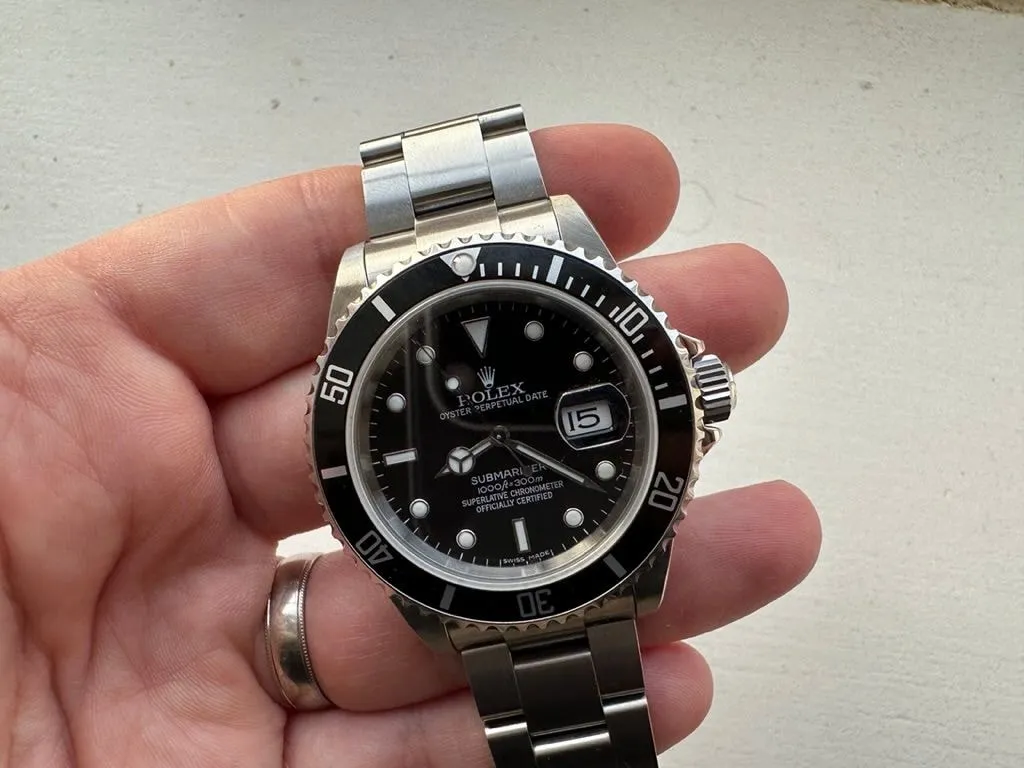
My 16610 Franken
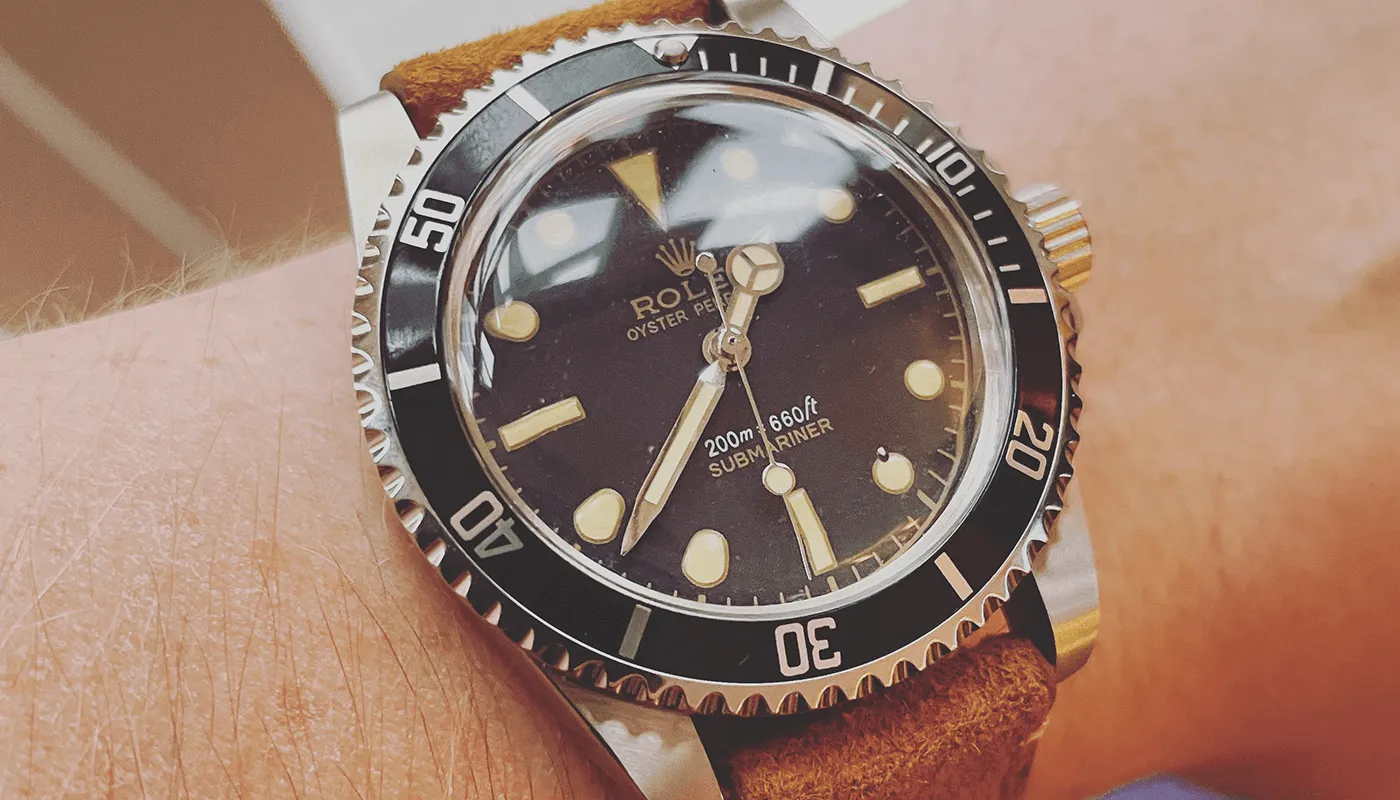
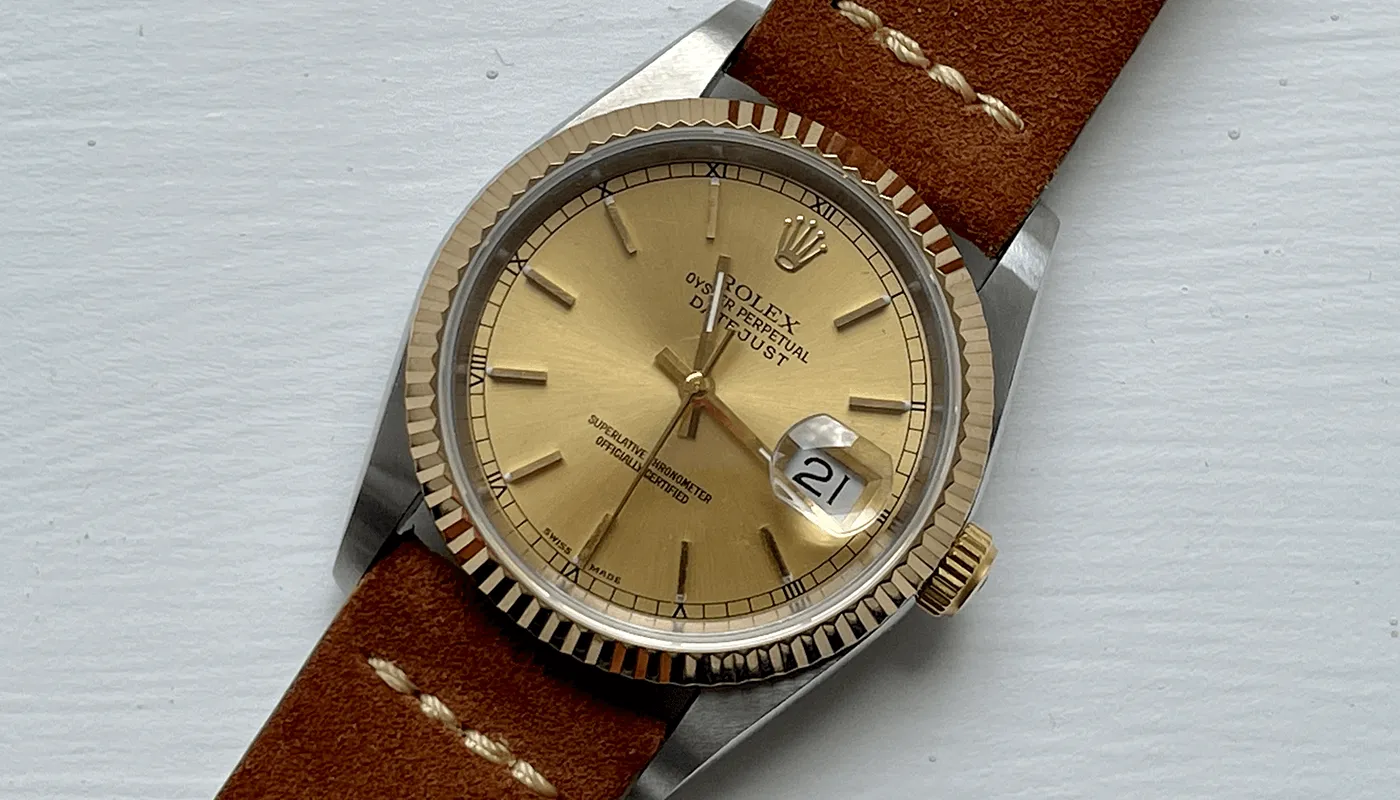
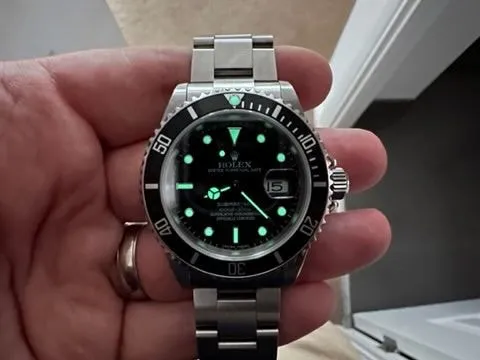
Mine started as a complete 16610 base watch, and I have since swapped in genuine Rolex parts where they make the biggest difference: a genuine bezel, a genuine crystal and a genuine date wheel. The movement was upgraded to a VR3135, which in my experience is the best of the 3135 clones. The dial is not genuine, so this is a franken rather than a genuine watch — a mix of genuine and aftermarket parts, like my two-tone Datejust franken.
Why the 16610?
The Submariner Date ref. 16610 replaced the 168000 circa 1988 (you will see 1987, 1988 or 1989 quoted) and ran until the 116610 replaced it in 2010. The main change was the Rolex calibre 3135 — 28,800 vph (8 beats per second), 31 jewels, about 48 hours of power reserve, hacking seconds, quickset date, and COSC chronometer certification (−4/+6 s/day). The 3135 measures 28.50 × 6.00 mm. The case is 40 mm across, 12.7 mm thick and rated to 300 m, with a 20 mm lug width and a Triplock crown. On wrist it wears slimmer and more classic than the modern 116610 "Super Case" that replaced it.
Collectors love the 16610 because it sits in a sweet spot: not as expensive as true vintage subs, but with proportions and character that the current ceramic-bezel models do not replicate. The aluminium bezel develops patina over time, the case has thinner lugs than a 116610, and the overall look is unmistakably Rolex.
Key reference variants worth knowing before you buy a base:
- 16610 (c.1988–2002) — drilled lugs for easy strap changes; hollow end links until solid end links arrived with the 93250 bracelet in 2000
- 16610T (2003–2010) — no lug holes (they were dropped after 2002), solid end links standard
- 16610LV "Kermit" (2003–2010)— green aluminium insert, 50th anniversary edition. You'll also see it listed as the "16610V", but that's the same reference
- Rehaut engraving (from ~2007)— inner bezel ring engraved with "ROLEX ROLEX ROLEX…" repeated; earlier watches have a plain silver rehaut
- Lume and dial text— tritium ("SWISS – T < 25") to about 1999, then "SWISS" only around 1999–2000, then "SWISS MADE" from around 2000–01 (sources differ by a year)
Base watches usually come in both LN (black) and LV (green) versions, with and without rehaut engraving. Pick the era you want to emulate before ordering.
Why Start from a Complete Base Watch?
A good complete base gives you a working, correctly proportioned watch on day one, so every part you change after that is an upgrade rather than a fix. What to look for:
- Good stainless steel and case finishing— don't pay extra for "904L": the genuine 16610 isn't 904L (that came with later references), so it doesn't make a base more accurate
- Correct 40 mm proportions — some bases oversize the lugs or thickness
- 3135 clone movement included — usually SH3135 or VR3135 (often listed interchangeably; avoid the older A3135)
- Press-fit aluminium bezel insert — no glue, markers engraved to correct depth like genuine
- Mod-friendly platform — designed around 3135 dimensions so genuine and high-quality aftermarket parts fit with minimal fuss
Choosing Your Base Watch
Before ordering, decide on these options:
- 16610LN (black) vs 16610LV (Kermit green)— LN is the classic daily wearer; LV is the collector's choice with the flat-4 insert debate for early serials, though the flat-4 hype is a bit overblown
- Rehaut engraving vs plain rehaut — plain rehaut suits pre-2007 builds; engraved rehaut suits 2007+ era. A stock plain rehaut is good enough to wear without modding
- Movement listing— bases are sold with an SH3135 or a VR3135. Pick the VR3135 if you can: it is the best 3135 clone I have used, and the one in my build. Neither has published specs, so check the beat rate on a timegrapher rather than assuming 28,800 vph, and make sure you are not getting the older A3135
- Bracelet — oyster bracelet with SEL (solid end links) is standard; plan whether you will wear on bracelet or swap to rubber/NATO
My advice: wear the watch stock for a few weeks first. A good base is genuinely usable out of the box — waterproof enough for swimming, solid timekeeping, and great looking on wrist. You will quickly discover which details bother you and which upgrades are worth the cost.
Upgrade Tiers — What to Change and When
Franken builds range from a few targeted swaps to full genuine-part conversions costing thousands. Here is a practical tier system:
Tier 0 — Stock base watch (wear as delivered)
Cost: base watch only (~$400–600 depending on dealer and version). The stock dial, hands, bezel insert, crystal, and movement are all usable. Lume is strong, case finishing is excellent, and timekeeping is typically within a few seconds per day.
Tier 1 — High-impact cosmetic swaps (~$100–300)
- Date wheel overlay or gen-spec date disc — stock date font is the most noticeable detail on wrist; a better date wheel transforms the dial side
- Cyclops clarity — some builders swap the crystal primarily for better cyclops magnification and AR coating
Tier 2 — Bezel and crystal (~$200–500)
- Genuine or high-quality bezel insert — the single best visual upgrade; aluminium patina on a gen insert is unmatched
- Prof/correct-height sapphire crystal— genuine spec is Rolex part 25-295-C with laser-etched crown at 6 o'clock; eliminates stock AR coating issues and gets cyclops height right
- Bezel gasket height— when swapping crystal and insert together, gasket height matters: measure the old gasket, as bases vary between ~2.5 mm and ~3.0 mm
Tier 3 — Movement and wearing parts (~$300–800+)
- Movement service or VR3135 swap — if the stock SH3135 develops stem or winding issues, a serviced movement or VR3135 upgrade improves reliability
- Genuine crown (703 series) — better threading, feel, and long-term durability
- Genuine or gen-spec hands — correct lume colour and finishing; expensive (~$200–300+) but noticeable up close
Tier 4 — Full franken (~$1,000–2,000+ in parts alone)
- Genuine dial — brass base with white gold applied markers; $500+ and hard to source, but transforms the watch
- Genuine bezel assembly — insert plus bezel ring
- Hybrid 3135 — gen parts movement built by a watchmaker; the ultimate upgrade but watchmaker-dependent
Most builders land at Tier 1–2 and call it done. Diminishing returns kick in fast above that unless you are chasing gen-level accuracy for personal satisfaction.
Why Not Swap to a 2813 or 2824?
This is the most important technical point in the whole build. If you have read my 2813 or 2824 movement reviews, you know those are excellent budget movements — but they are not drop-in replacements for a 3135 case.
Swapping from SH3135 to an ETA 2836 or Asian 2824 in a 16610 base case creates a cascade of problems: wrong dial feet spacing, incompatible hand hole sizes, different stem and crown threading, different case ring dimensions, and date wheel position mismatches. Forum builds that attempted this consistently report it is not worth the pain unless you are an experienced modder with custom parts.
Stay in the 3135 ecosystem. Upgrade within SH3135 → VR3135 → serviced/hybrid 3135. Your base watch's dial, hands, and case were designed for this movement family.
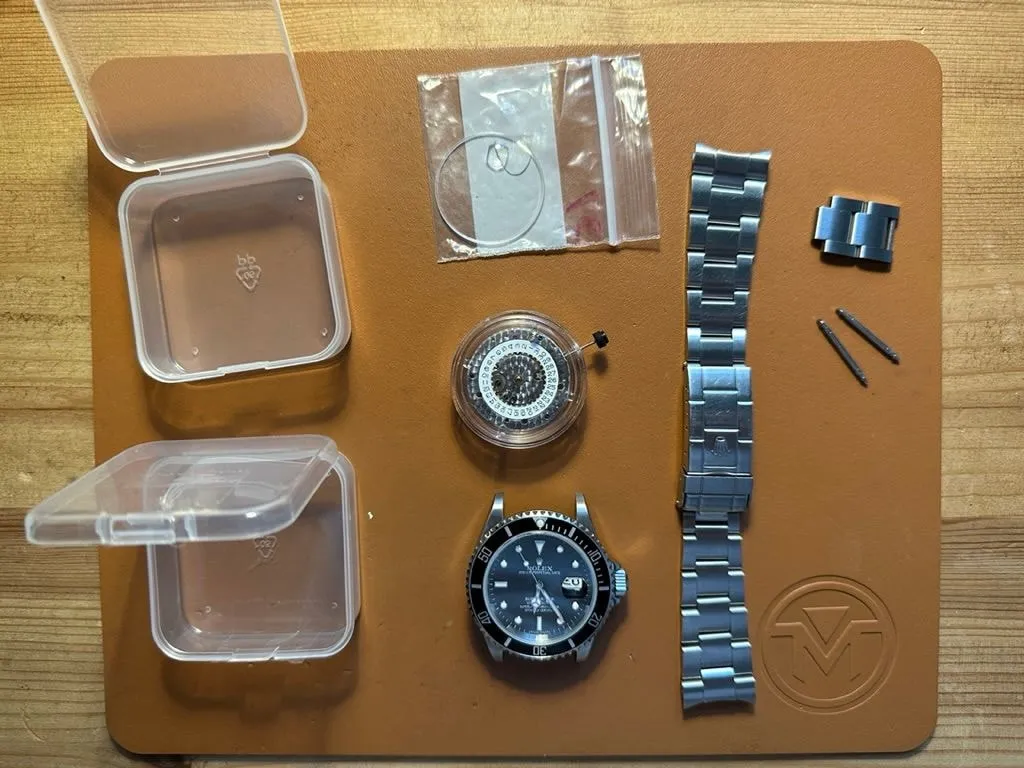
Tools You Will Need
A base watch build needs more specialised tools than a scratch 2813 build because you are working with an integrated 3135 case, press-fit crystal, and click-spring bezel. At minimum:
- Rolex-style case back opener — friction fit tool for the oyster case back
- Hand removers and hand press set — for dial-side work
- Movement holder — essential when working on the 3135 outside the case
- Pin punch set — for removing bracelet spring bars and some stem work
- Bezel removal tool — or careful technique with a case knife and steady hands
- Crystal press — required for crystal swaps; do not hammer crystals in
- Digital calipers — verify gasket and crystal heights before pressing
- Magnifying glasses — 10–25x for hands, date wheel, and stem work
- Plastic tweezers and finger cots — never touch a dial with bare fingers
- Rodico / dust blower — dial cleaning between steps
I cover affordable starter versions of all of these in my beginner tool kit guide.
Teardown — Stripping the Base Watch
Work on a clean, padded surface. Photograph every step — reassembly is much easier with reference photos. Keep screws in labelled containers; case screws are tiny and easy to lose.
1. Remove the bracelet
Use a spring bar tool or pin punch to compress the spring bars at the lugs. Most base bracelets use solid end links — note which way the SEL sits for reassembly. Set the bracelet aside in a soft pouch.
2. Open the case back
Fit the case back tool to the notches on the oyster case back. Apply firm, even pressure and unscrew counter-clockwise. Inside you will see the SH3135/VR3135 movement, case ring, and case back gasket. Inspect the gasket — replace if compressed or damaged.
3. Remove the movement
Pull the crown to the winding position. Locate the stem release (small lever or screw on the movement — SH3135 uses a push-button stem release similar to genuine 3135). Depress with a pin tool while gently pulling the crown out. The movement should now drop out with the case ring once the two case clamps are loosened.
Tip: if the stem will not release, never force it. A stuck stem is a common SH3135 issue — see the movement section below.
4. Remove the dial and hands (if upgrading)
Place the movement in a holder. Use a hand remover to lift seconds, then minute, then hour — always seconds first to avoid bending the hour hand. The dial is held by dial feet clamped under two screws on the movement; loosen these screws (do not remove them fully) and lift the dial off.
The same hand-setting technique from my Datejust build guide applies here: set the date to flip at midnight before placing hour and minute hands at 12.
5. Remove the bezel assembly
The bezel uses a click spring and retaining ring. Remove the bezel insert first if swapping it — on most bases this is a press fit, not glued. Use a bezel tool or carefully work around the edge with a case knife on a protected surface. Remove the click spring (it will fly — work inside a zip-lock bag if you have lost one before). Note the orientation of the spring and ring.
Important: stock bezel assemblies often will not accept a genuine insert without modification. You may need to sand the inner lip of a gen insert lightly, or swap to an aftermarket bezel ring designed for gen inserts. Some builders report gen inserts fitting perfectly on LN versions — test before committing.
6. Remove the crystal (if upgrading)
This requires a crystal lift tool or press with dies sized for the 16610 case. Heat is sometimes used on genuine watches; on a base watch, a press with correct dies is usually enough. Remove the crystal gasket and measure its height with calipers before ordering replacements.
Key Upgrades in Detail
Bezel insert swap
The bezel insert is the highest-ROI upgrade on any 16610 build. Genuine Rolex aluminium inserts develop a subtle fade and patina that aftermarket inserts rarely match.
Steps for fitting a gen or gen-spec insert:
- Clean the bezel ring and apply a thin layer of silicone grease to the click track
- If the insert is too tight, sand the inner edge lightly on fine wet-and-dry paper — remove material gradually and test-fit often
- Use the table edge with paper protection as leverage to snap the insert in — avoid levering against the lume pip
- Slightly convexing a gen insert before pressing helps it seat on stock bezels that run a fraction tight
- Grease the click spring, seat the ring, and test rotation — should be firm with 120 clicks
Crystal swap
Stock crystals are functional but often have heavy AR coating and lack the laser-etched crown at 6 o'clock. A correct-spec sapphire (25-295-C or quality aftermarket equivalent) improves cyclops magnification and side-profile accuracy.
Assembly order matters:
- Place the gasket in the case seat first
- Press the crystal in with a crystal press and correctly sized die
- Install the crystal retaining ring
- Verify height: the crystal should sit fractionally above the bezel insert lip — gasket height controls this, so match the height you measured
Date wheel upgrade
The date disc is one of the easiest and most visible upgrades. Remove the old disc (two screws on the movement), install the replacement, and verify date change at midnight before closing the watch.
Watch out: genuine date discs can be slightly thicker than aftermarket discs and cause the date not to flip cleanly at midnight — the date may half-change until manually advanced. This is a known franken issue solvable with a gen-spec hybrid disc or careful shimming; a watchmaker can adjust if needed.
Movement — service vs swap
The SH3135 found in most base watches is a decent 3135 clone. Common issues reported on forums: stem not snapping back after time-setting (requires stem/clutch adjustment), noisy rotor, and occasional amplitude loss after a year of wear.
Options:
- Service the stock movement — a watchmaker familiar with 3135 clones can regulate, lubricate, and fix stem issues for $100–200; often the best value
- Swap to VR3135 — newer generation clone, closer to gen spec; drop-in in base cases if you stay in the 3135 family. This is the upgrade I made
- Hybrid/gen movement — the nuclear option; 90%+ gen parts; expensive and watchmaker-built
Avoid the older SA3135 unless you already own one — spare parts are scarce and failures are harder to repair.
Crown upgrade
Genuine Rolex crown (703 series for date models) improves feel and longevity. The swap requires removing the movement, extracting the stem, transferring the new stem to the movement (or cutting to length), and verifying water resistance after reassembly. Match crown tube threading to your case — most base cases accept gen-spec crowns with minimal issue.
Known Base Watch Quirks
Go in with eyes open on these common traits:
- Shorter lug-to-lug — base 16610 cases often run slightly shorter than genuine; noticeable in side-by-side comparison but not on wrist
- No lug holes on later cases — matches 16610T gen spec but limits easy strap swaps; some builders drill lug holes for vintage aesthetic (not reversible — think carefully)
- Sharp case edges — some examples benefit from light brushing to soften chamfers; personal preference
- Stock bezel vs gen insert compatibility — varies by batch; always test-fit before tearing down
- Rehaut versions — engraved and plain rehaut are separate SKUs; do not assume you can swap rehaut rings easily
Reassembly and Final Checks
Work in reverse of teardown. Critical checkpoints:
- Date flips cleanly at midnight with hands set correctly
- Bezel rotates smoothly with no grinding; insert secure with no play
- Crown winds smoothly in the first position, the date quick-sets in the second and the hands set in the third
- Hands clear the crystal with no touching at any position
- Case back gasket greased and case back torqued firm with case tool
- Bracelet SEL aligned flush with case lugs
If you have access to a basic timing machine, check amplitude and beat error after reassembly. There are no published specs for the 3135 clones, so the only useful figures are your own; for reference, a genuine COSC-certified 3135 averages −4/+6 s/day. If you are choosing a clone, go for the VR3135: it is the one in my build and the best 3135 clone I have used.
For water resistance: if you have opened the case, assume swimming pressure is compromised until pressure-tested. Many builders are comfortable with daily splash resistance after a careful gasket re-grease, but not hot showers or diving without a proper test.
Approximate Cost Breakdown
Rough budget planning for a typical Tier 1–2 16610 franken build (GBP/USD approximate):
- 16610 base watch — $450–600
- Date wheel upgrade — $30–80
- Gen or gen-spec bezel insert — $80–200
- Crystal (aftermarket spec) — $40–80
- Crystal gaskets — $5–15
- Movement service — $100–200
- Tools (if starting fresh) — $50–150
Total for a solid franken: roughly $750–1,100 all in. Full gen-dial territory pushes well past $1,500 in parts alone — before watchmaker labour.
My Recommended Build Path
If I were starting fresh today, this is the sequence I would follow:
- Order a 16610LN base with plain rehaut (pre-2007 look) and VR3135
- Wear stock for 2–4 weeks — establish baseline timekeeping and find what nags you
- Swap date wheel first — cheapest, biggest dial-side impact
- Source gen or high-quality bezel insert; test-fit before full teardown
- Swap crystal if cyclops or AR coating bothers you
- Service movement at 12 months or if stem issues appear
- Stop there unless you are chasing gen-level — diminishing returns above Tier 2
The Finished Watch
A well-executed 16610 franken sits in a category of its own: classic five-digit proportions, daily-wear reliability, and a build path you can stage over months without ever being without a watch on wrist. It is a very different project from my 5513 scratch build — less about assembling parts from scratch, more about knowing which upgrades matter and when to leave well enough alone. For a closer look at how it compares with the real thing, see my genuine vs franken 16610 comparison.
The 16610 is the Submariner I would pick if I could only own one sub: modern enough to wear every day, vintage enough to have character, and with a good base watch, close enough to start enjoying immediately while you perfect it over time.
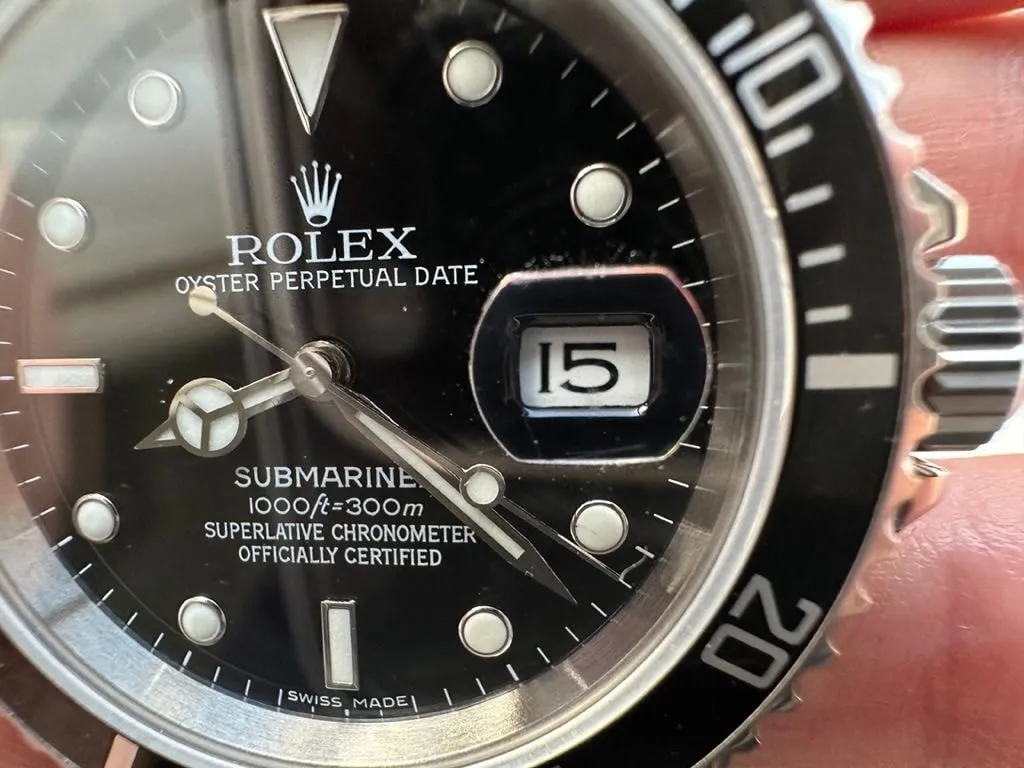
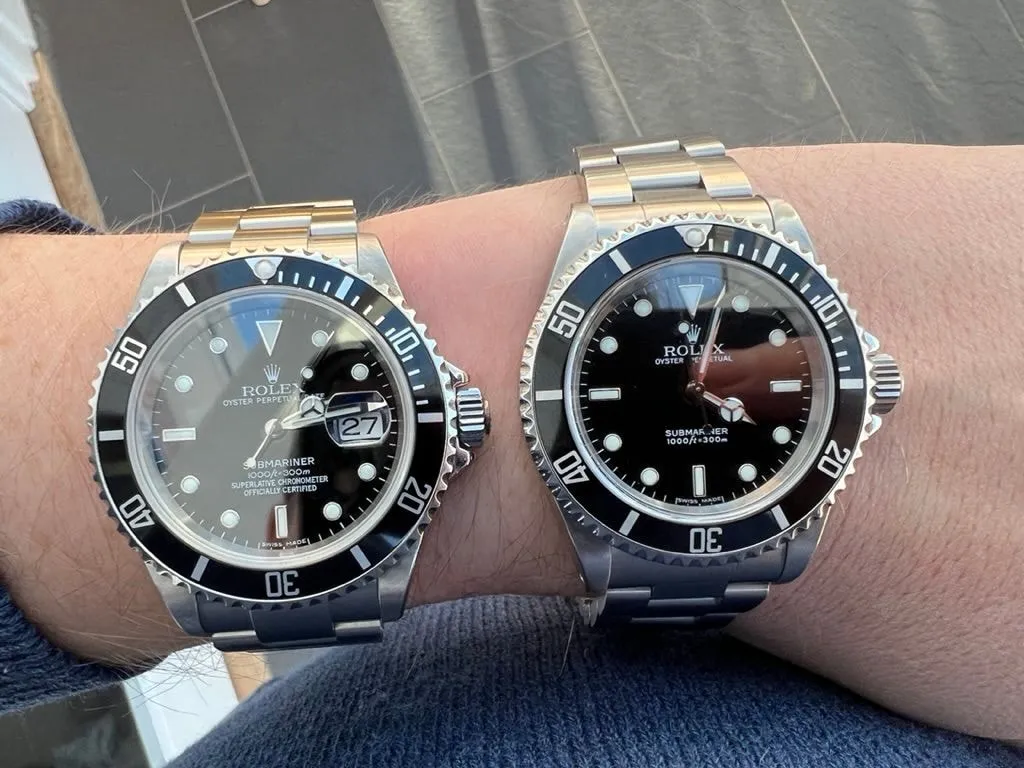
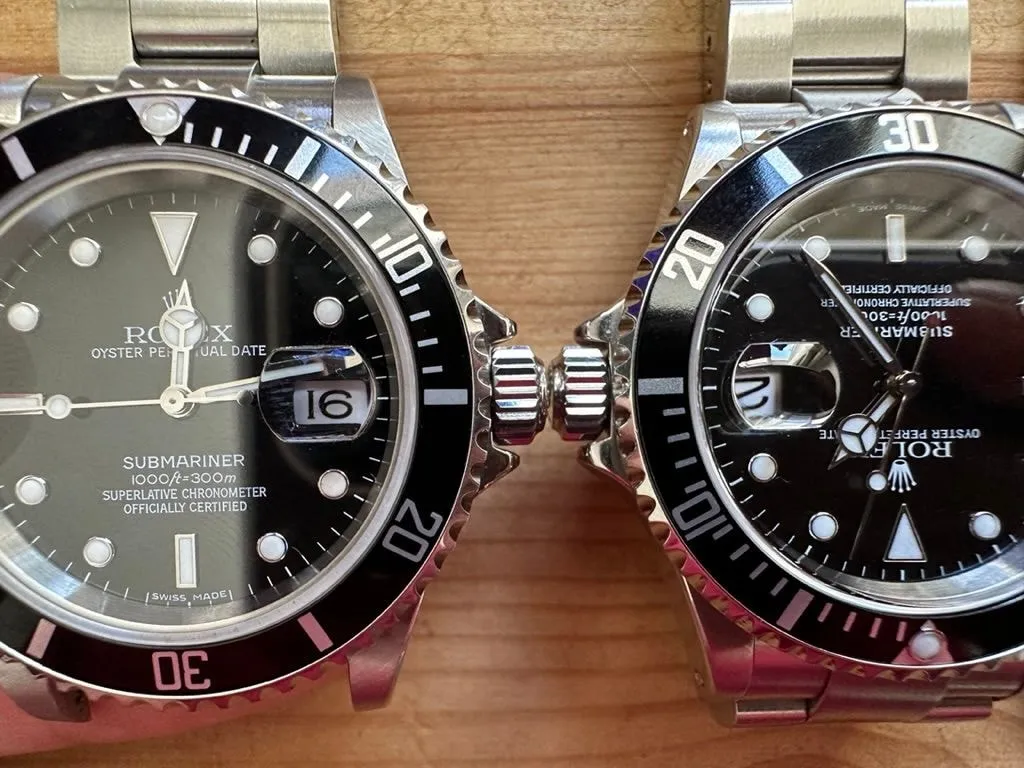
Below, my franken is on the left next to a genuine no-date Submariner, and then laid crown to crown with a genuine 16610 for comparison.
Frequently asked questions
What is a Submariner 16610 franken?
A franken is a watch that mixes genuine Rolex parts with aftermarket ones. Mine started as a complete 16610 base watch and now has a genuine Rolex bezel, crystal and date wheel, a VR3135 movement and an aftermarket dial.
Which 3135 clone movement is best for a 16610 build?
The VR3135. It is the movement in my build and the best 3135 clone I have used. Avoid the older A3135 and SA3135, which are harder to get parts for.
Can I put a 2813 or 2824 in a 16610 case?
Not easily. A 16610 base is designed around the 3135, so a 2813 or 2824 brings the wrong dial feet spacing, hand hole sizes, stem threading, case ring and date wheel position. Stay with a 3135 clone.
What is the best first upgrade on a 16610 franken?
The bezel insert gives the biggest visual change, and the date wheel is the cheapest upgrade with the most impact on the dial side. A genuine crystal improves the cyclops magnification.